background

Raman spectroscopy: VISERION

Raman spectroscopy is based on inelastic scattering of the incident laser beam of a low number of photons at different frequencies. Due to the type of transition involved (vibrational transition), this spectroscopic method ensures high specificity by analyzing the re-emission bands specific to the chemical groups. It is particularly suited to aqueous liquid media due to the near-inactivity of water in Raman emission because of its very low polarizability, but can also be of added value for the characterization of solid samples.

background

A SYSTEM SUITABLE FOR THE LABORATORY AND FOR INDUSTRIAL ENVIRONMENTS

VISERION enables in situ, non-destructive analysis of both solid and liquid samples. Two excitation wavelengths are proposed:

  • 785 nm Raman laser:

The most popular excitation wavelength, offering a good compromise between Raman signal intensity, sensitivity to fluorescence, measurement range, cost and overall performance.

  • 830 nm Raman laser:

A wavelength minimizing fluorescence which is more suitable for certain dark-colored samples (dyes, oils, colored polymers), but which also increases the integration time and affects the measurement range.

The system is equipped with a low-temperature thermo-electric cooling unit, ensuring low-noise measurements. This detector provides a great compromise between measurement speed, sensitivity and implementation costs. The analyzer is compatible with pharmacopoeia standards (USP858, Ph.Eur. 2.2.48).
 

TWO POSSIBLE CONFIGURATIONS

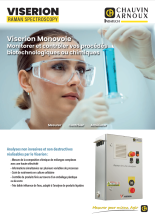
  • one-channel configuration: one single measurement channel offering a cost-effective solution for standard applications
  • four-channel configuration: four simultaneous measurement channels, each equipped with their own laser, offering a flexible tool that can analyze batches or continuous processes in a more rugged way
background

TECHNOLOGY INCORPORATING MEASUREMENT AND ANALYSIS SOFTWARE

Both Viserion systems include an industrial PC with the Viserion Ready firmware. This 21 CFR part 11 compliant GUI allows to

  • Modulate the acquisition parameters such as integration time and number of scans, power of the laser(s)
  • Integrate chemometric models (eg PCA, PLS, ANN, SVM) from external software packages such as PLS_Toolbox (Eigenvector) or SIMCA-Online (Sartorius)
  • Communicate via OPC-UA or TCP/IP to enable full production automation and implementation of feedback loops to guarantee process performance and quality at all times